Let’s start with the why — because it’s hard to find much logic in it.
The government’s official line is that it wants to encourage UK savers to invest in shares. A more direct way to do that might be to tackle the actual barriers to investing – scrapping stamp duty on UK share purchases, say, or investing in financial education to address people’s (often justified) wariness of the stock market.
Instead, the chosen method is to make cash saving less attractive by restricting how much of it can go in a Cash ISA. It’s a bit like trying to get more people to cycle to work by making it harder to park the car, rather than building better cycle lanes.
A more cynical reading is that this is really about capping the tax relief available on the nation’s most popular savings vehicle, dressed up as a nudge towards investing.
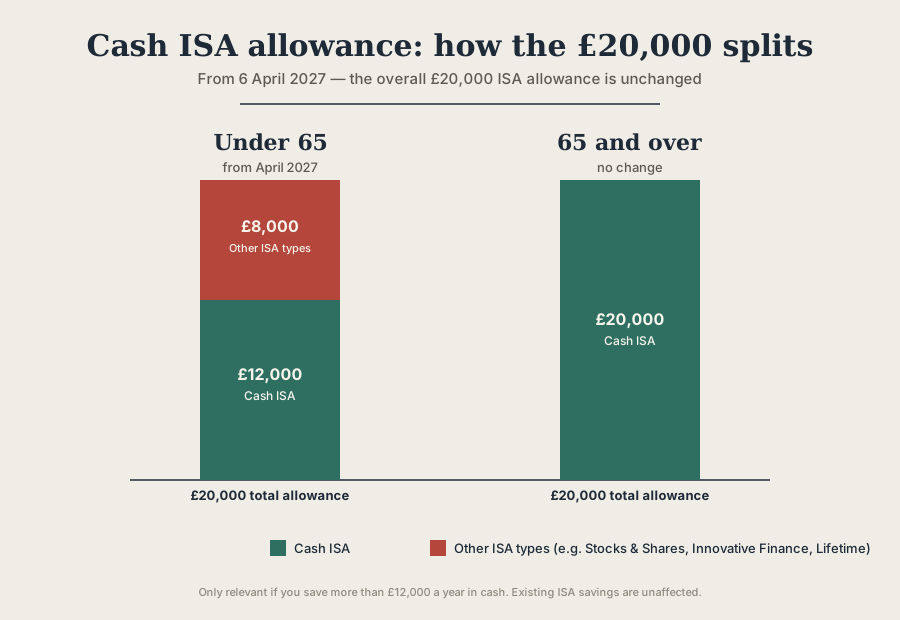
One thing worth saying clearly up front: none of this matters unless you’re saving more than £12,000 a year in cash. If your annual cash saving is below that, the changes don’t touch you at all. That’s a smaller group than the government’s framing might suggest, but for anyone who does save more heavily in cash, it’s a real shift worth understanding.
How much you can save in a Cash ISA
If you’re 65 or over, nothing changes: you can still save the full £20,000 a year into a Cash ISA. Why 65? No obvious reason has been give but linking it to State Pension Age (currently 66, rising to 67) would arguably have made more sense.
If you’re under 65, your Cash ISA allowance drops to £12,000 from April 2027. Again, don’t look too hard for the logic behind that number as there doesn’t appear to be much.
There’s also a question of who this actually targets. The average cash ISA holds around £13,000, but that’s a balance built up over years, not an annual figure. The real test is how much people typically pay in each year, and for most savers, that’s well short of even the new £12,000 cap. If that’s right, the £12,000 limit isn’t really constraining “the average person” at all, it’s aimed at a smaller group of higher savers, while being sold as a policy for UK savers as a whole.
What about cash inside a Stocks & Shares ISA?
Here’s where it gets technically messy. A Cash ISA can only hold cash. A Stocks & Shares ISA can hold cash and a much wider range of assets.
The Stocks & Shares ISA allowance stays at £20,000, which immediately creates a loophole. Without a fix, someone under 65 could simply hold £20,000 in cash inside a Stocks & Shares ISA, sidestepping the new £12,000 cash limit entirely.
HM Treasury spotted this, and its answer is to add a new layer of complexity: a flat 22% charge on any interest earned from cash held within a Stocks & Shares (or other non-Cash) ISA. It’s genuinely flat – the same rate applies whether you’re a basic-rate, higher-rate, or additional-rate taxpayer, or pay no income tax at all. That means someone who would otherwise pay 40% or 45% on savings interest gets a comparative break, while someone who would normally pay no tax at all is now charged 22% regardless. Individual savers won’t need to declare it themselves as ISA managers will pay it directly to HMRC.
Transfer restrictions
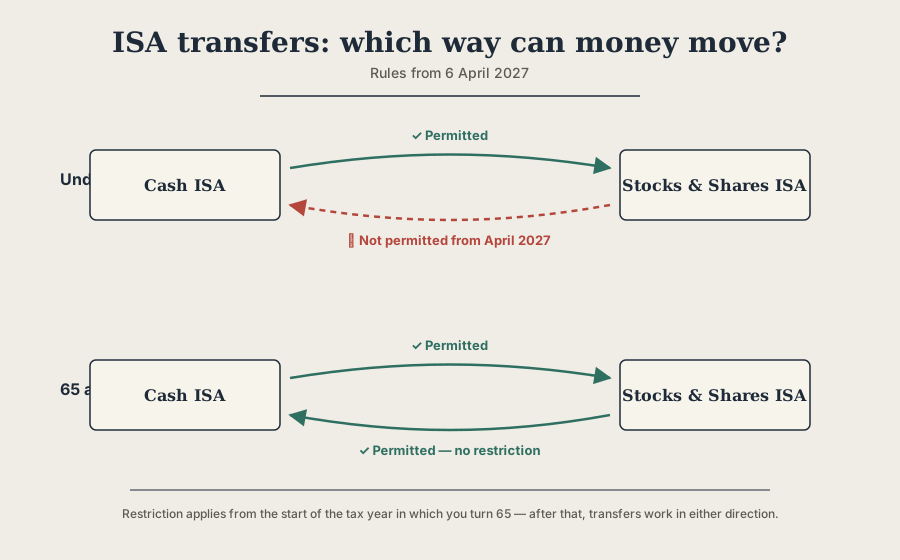
There’s one more piece of the anti-circumvention puzzle: transfers. From April 2027, under-65s will no longer be able to transfer money from a Stocks & Shares ISA (or Innovative Finance ISA) into a Cash ISA. Without this, someone could simply accumulate cash in an investment ISA, where inflows aren’t capped at £12,000, and then shift it across into a Cash ISA, defeating the whole purpose of the lower limit.
The restriction only works in one direction, though. Transfers from a Cash ISA into a Stocks & Shares ISA remain unrestricted, so money can still move from cash into investments freely, just not back again.
For those aged 65 and over, none of this applies. The transfer restriction is lifted entirely once you reach the tax year in which you turn 65, so older savers retain full flexibility to move money between Cash and Stocks & Shares ISAs in either direction.
And a word on money market funds
Money market funds are the one “cash-like” asset the government still allows tax-free inside a Stocks & Shares ISA, but only as a partial holding, not the whole account. In other words, you can’t simply swap your cash for a money market fund and call it “investing” to dodge both the £12,000 limit and the 22% charge. It’s a reasonable safeguard on its own terms, but it’s also another example of a fairly simple idea requiring an ever-growing list of carve-outs and definitions.
In practice, though, the “not 100%” wording leaves a fairly obvious gap. Someone under 65 could, for example, hold £7,900 in money market funds and just £100 in a UK equity fund or gilt within their Stocks & Shares ISA. This would mean they avoid both the 100% threshold and the 22% charge, while still holding the vast majority of that money in a cash-like asset. Commentators in the investment industry have already flagged this as one of the more obvious workarounds on offer. It says something that a rule meant to close one loophole may simply open another.
The cynical bit: how providers might actually respond
Here’s a prediction worth watching: don’t be surprised if some Stocks & Shares ISA providers simply stop paying interest on cash held in those accounts altogether.
This wouldn’t be unprecedented. In December 2023, the FCA wrote to 42 investment platforms, including Hargreaves Lansdown and AJ Bell, after finding that most were retaining a significant slice of the interest earned on customers’ cash balances, rather than passing it on. Some were even charging customers a fee to hold cash and keeping the interest on it, a practice the regulator branded “double dipping.” Given that history, it’s not a stretch to expect some providers to respond to the new 22% charge by quietly cutting or scrapping the interest they pay on cash altogether, rather than eating the admin cost of collecting and reporting the tax.
If there’s no interest paid, there’s no charge to calculate, collect, and report. Less admin for the provider, and the margin they’d otherwise have paid out as interest can simply be retained instead. The saver loses out either way: no interest, and no clean tax treatment to compensate.
What this means for you
- Only relevant if you save over £12,000 a year in cash: if your annual cash saving is below that, these changes don’t affect you at all.
- Aged 65 or over: nothing changes. You can keep saving up to £20,000 a year into a Cash ISA.
- Turning 65 soon? You get the full £20,000 allowance for the entire tax year in which your 65th birthday falls, not just from the birthday itself.
- Under 65: from April 2027, your Cash ISA contributions are capped at £12,000 a year. The overall £20,000 ISA allowance is unchanged but the remaining £8,000 would need to go into a Stocks & Shares ISA, Innovative Finance ISA, or Lifetime ISA if you want to use it.
- Transferring between ISA types: if you’re under 65, you won’t be able to move money from a Stocks & Shares ISA into a Cash ISA from April 2027, only the other way round. This restriction doesn’t apply once you’re 65 or over.
- Between now and April 2027: the current £20,000 Cash ISA allowance still applies. If you’re under 65 and rely heavily on cash saving, this is your last full window to use it.
- Existing savings are protected: money already in a Cash ISA stays fully tax-free as the changes only affect new contributions from April 2027 onwards.
- If you hold cash in a Stocks & Shares ISA: check what interest rate you’re actually being paid once the new rules land. Don’t assume it will stay the same.
- Worth reviewing: how much of your saving genuinely needs to sit in cash versus how much could reasonably be invested over a longer time horizon.
A final worry: this may just be the thin end of the wedge as £12,000 is a fixed figure with no stated mechanism for annual uprating. Even standing still, it will shrink in real terms every year through fiscal drag, quietly capturing more savers into the net over time without anyone having to announce a fresh cut. And given that the £12,000 figure was chosen with, on the evidence available, no clear rationale at all, there’s nothing to say a future Budget couldn’t reduce it further under the same “encouraging investment” banner. Once a principle like this is established, it tends to be easier to tighten than to reverse.